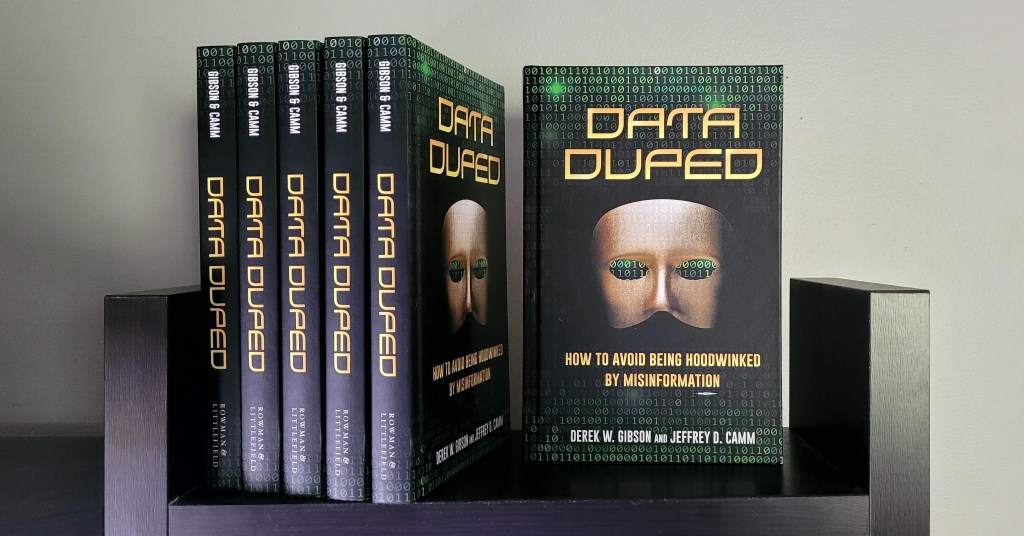
With the launch this month of our book, Data Duped: How to Avoid Being Hoodwinked by Misinformation, we hope we are bringing curious readers closer to understanding data. Not just the math and statistics, but also provide some insights into how data is used in many of our everyday interactions. For example, that not-so-random advertising you see on Facebook, and the “recommended for you” on Amazon and other places, are all driven by little bits of yourself that you knowingly or unknowingly shared along the way. There is some of the “creepy” factor when this happens, but it is mostly a result of advertisers and news media trying to give you exactly what you want. At times it is a miss, and at others, it is amazingly convenient. But how does all of that work and what are the boundaries of good data use and bad?
In the book, we explore some examples both among your everyday decisions, like online shopping and social media news, and other bigger decisions such as saving for retirement, planning college, or even finding a soul mate. The point is these are all decisions we face and without your participation, data provided by others might be nudging you in some predetermined direction.
Avoiding that nudge is the core of this book. How do you prevent yourself from being hoodwinked? The best place to start is to begin by building your very own data defense. Knowing more about how these systems work, looking out for the motivations of advertisers and news media, and checking otherwise dubious claims are among the tools we provide.
There is never a shortage of data and the rate of its use and integration into our lives is growing at an astonishing pace. The advance of AI tools such as ChatGPT and the many other variations will complicate how we navigate our personal journeys – becoming more difficult to discern truth from fiction, and certainty from nonsense. Complicating things along the way will be the juxtaposition of some truth with falsehoods – the former giving just enough credibility to make the latter believable. And when something is just a bit believable our own biases kick in and we inch closer to being Data Duped.
We hope you all enjoy the read.

 Data Duped