AI generated content and algorithm-driven social media are overpowering traditional news sources in a trend the sees no slowing down.
The Washington Post is cutting a third of their staff. It is a significant number and a significant moment in journalism. Since 1877, the Post has been a pillar of investigative journalism, earning numerous Pulitzer Prizes and playing a defining role in holding people accountable, notably during Watergate.
Fewer Journalists Means Less Facts
Since 2017 they have carried the banner “Democracy Dies in Darkness” and right now with the reductions in the newsroom this feel less like a slogan and more like a literal warning. Fewer editors and reporters, means fewer resources to check facts, verify claims and counter the AI generated slop trying to pass as “news”.

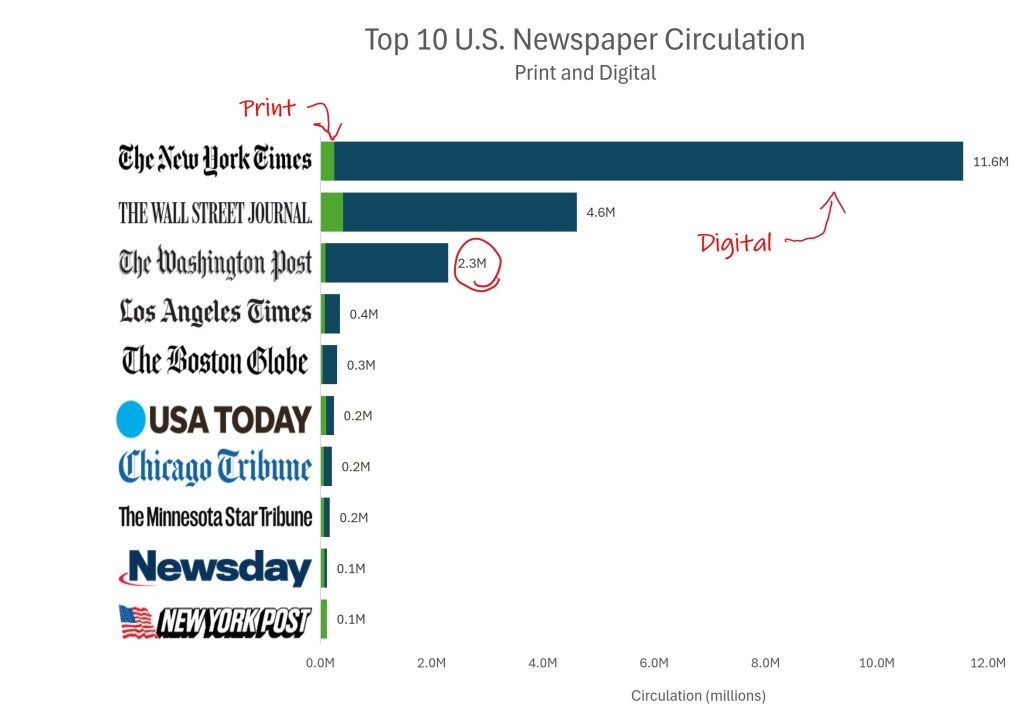
While the Post reaches 2.3 million readers (behind the New York Times and The Wall Street Journal), traditional news sources are less often the place we get information. Consider these facts:
- 53% of U.S. adults get news from social media (Pew Research Center, Sept 2025)
- Facebook servers as a news source for roughly 74 million U.S. users
- X/Twitter functions as a news source for an estimated 40 million users
Too Much Noise
When a major news story occurs the first wave of information now comes from social media almost instantly. Individuals, especially those working to earn revenue from the platforms are quick to provide information…any information. It might be simply their opinion or speculation about what is happening, but more we are seeing AI generated images and video to fit that narrative. When the December 2025 Bondi Beach tragedy was just hours old, social media was filled with posts misidentifying people involved in the shooting. Fear, rage, racism were mechanisms the algorithms found successful for online engagement. It pushed AI stories into people’s news feeds. It was about views, not truth.
Meanwhile, traditional newsrooms were working sources, verifying what was real. Doing the real research required as journalists. Their job was ever more difficult with crowded misinformation, like a firefighter trying to save a building while others are fanning the flames.
…not all news sources are equal when it comes to quality and accuracy
Social media as a “news” outlet has the attention of many millions more people than the Washington Post could every gather. However not all news sources are equal when it comes to quality and accuracy. Professionally journalists at the Washington Post, The Wall Street Journal, and others are rewarded for their research by their peers with awards like the Pulitzer Prize. There is no such comparison for online influencers, which is telling. Do we want to be entertained or do we want accuracy in the news stories we read?
The Verification Burden
Social platforms now command attention at a scale that legacy journalism cannot match. But attention for “views” and “likes” is not the same as accuracy. It just does not have the same rigor for the truth. We know this intuitively, but in practice having grown accustom to believing what we read from authoritative looking sources, people are more often accepting. Increasingly this means that you and I have the burden of identifying the truth among the noise. And lately it seems there has been a lot more noise.

 Data Duped